

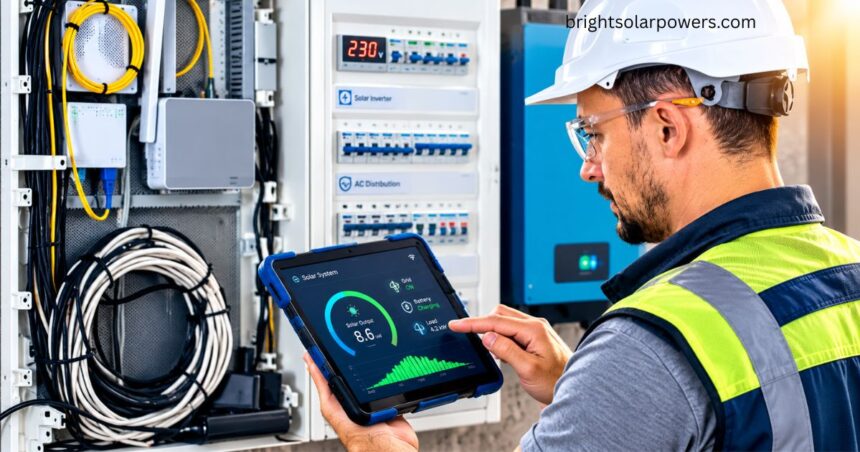
This guide walks you through the whole photovoltaic system one question at a time, using real numbers from manufacturer pages.
What MPPT charge controller setup?
An MPPT charge controller sits between your solar array and your battery, and it hunts for the best working point of the panels.
The tracking algorithm reads voltage and current, then adjusts the load until their product peaks. A buck converter, also called a step-down converter, lowers panel voltage to match the battery while it raises current.
This DC to DC conversion lets a PV module feed a 12 volt battery with little waste, and good units reach over 99 percent tracking efficiency and strong charging efficiency.
Is an MPPT controller worth it in Orlando?
Yes, it pays off in Orlando I recommend MPPT for any array above 200 watts, which is my own rule of thumb.
Afternoon thunderstorms roll through on many summer days, and cloud cover cuts sunlight intensity and solar irradiance within seconds.
MPPT reacts to those swings and keeps PV input power flowing. Orlando offers long sun hours, and peak sun hours usually run highest in spring, so a controller with 99.97 percent PV module utilization and strong machine efficiency repays its cost quickly.
What size controller do I need?
Divide your array watts by battery voltage, then add 25 percent for safety.
Do your load calculation first, because loads decide the bank and the bank decides the array sizing. Then handle string sizing by keeping panel voltage inside the controller window.
Which battery types work with an MPPT charge controller?
Most modern units charge lead-acid battery, gel battery, and lithium battery types without extra hardware I set it before I connect any panels.
The lead-acid family also includes AGM battery, flooded battery, and sealed battery designs, and each wants slightly different voltages.
How do I pick the right system voltage?
Choose your system voltage by load size. A 12V system suits vans and small cabins, a 24V system suits mid-size homes, and a 48V system suits larger setups. Higher voltage means lower current and thinner cable.
A 36V system is rare, though inverter.com sells 80 to 120 amp units that support it, and big sites run a 96V system. Most budget units offer automatic voltage detection at startup. Check the battery voltage range on the label, because SRNE’s MC series accepts 9 to 64 volts.
What do the three charging stages do?
Each charging stage follows the state of charge, and float charge offsets self-discharge. Lead-acid banks also get an occasional equalize charge to mix the electrolyte.
Set the float charge voltage, equalize charge voltage, and MPPT charge controller setupmaximum charge current from your battery maker’s sheet, because inverter.com’s 96 volt model defaults to 110 volts float and 113.6 volts equalize.
Where should I mount the controller?
Mount it on a cool, dry wall near the battery, inside a shaded garage or utility room. Short cable runs cut loss and keep the mounting location easy to inspect.
Leave open ventilation around it, because a unit with natural cooling runs silent while a cooling fan model needs clear airflow.
Most units carry only an IP21 protection level, so a ventilated enclosure matters. Check the operating temperature, humidity rating, and altitude rating; inverter.com’s 96 volt model runs from minus 10 to 45 degrees Celsius and up to 3,000 metres.
Heat derating starts in hot cabinets, so temperature rise protection cuts power at 80 degrees Celsius and over temperature protection trips at 85.
What tools and safety gear do I need?
Gather insulated tools, a multimeter, and proper safety gear before you touch a wire. Solar panels make voltage whenever light hits them, so you treat every cable as live. I wear eye protection and rubber gloves on every job.
Orlando projects usually need a permit, so call your city or MPPT charge controller setup county building office first. Follow the National Electrical Code, and hire a licensed electrician for any utility interconnection with OUC or Duke Energy.
Add a disconnect switch, solid grounding, lightning protection, and surge protection, because Central Florida sits inside the area nicknamed Lightning Alley.
How do I size and protect the wiring?
Use copper cable thick enough to hold voltage drop under 3 percent, and pick the wire gauge from your amps and run length. Crimp each cable lug tight and seal it with heat shrink. Thin wire melts first, so I always go one size up.
Protect every circuit with a fuse or DC breaker on the battery side and a circuit breaker or combiner box on the panel side.
Use a busbar for multiple battery cables and a quality MPPT charge controller setupsolar connector on the panel leads. Tighten each terminal block to the terminal torque in the manual, and check cable insulation for UV cracks.
How do I wire panels in series or parallel?
Use series connection to raise voltage and parallel connection to raise current, then keep the total below the controller’s max PV input voltage. A PV string of two or three panels works for most small systems. Always add up the open circuit voltage, not the rated number.
Orlando winter mornings now and then dip near freezing, and cold weather voltage climbs as cell temperature falls, so leave about 10 percent of margin.
Compare your array against the recommended PV voltage and the limit input voltage; Ampinvt’s AP series allows 150 volts open circuit, while some SRNE models handle 250. Finish with a polarity check using a multimeter before you close any breaker.
In what order do I connect everything?
Connect the battery first, then the panels, and the load last. Follow the wiring diagram in your manual, and never skip the order. The controller wakes MPPT charge controller setupfrom battery power and learns what it faces.
This order protects the reverse connection protection circuits from surprises. During commissioning, check the MPPT operating voltage range, the PV input low voltage point, the PV input overvoltage point, and the recovery point.
Inverter.com’s 96 volt unit cuts out below 120 volts and above 230 volts, and you finish with parameter setting and load output mode.
How do I program the controller settings?
Step through the menu with the multi-function button and watch the LCD display confirm each change. Start from the factory default and change only what your battery needs. If you get lost, use the reset option and begin again.
Plug in the battery temperature sensor so temperature compensation trims charge voltage as the bank heats up; inverter.com lists about 3 MPPT charge controller setup millivolts per degree Celsius per 2 volt cell.
The screen then shows real-time current, daily power generation, and cumulative power generation, which I log every week.
Check the maker’s site for a firmware update too, because some models gain features that way.
Can I monitor the controller from my phone?
Yes, many models support Bluetooth with a mobile app, and others add WiFi monitoring through a plug-in module. You see voltage, current, and charge status without walking to the wall.
SRNE and Ampinvt both sell controllers with these options.
Wired links include RS485 communication and RS232 communication, which feed a data logger through the maker’s communication protocol. A remote control panel puts the screen across the room, while the DSP control chip inside runs the tracking logic. Open the fault record when something trips, because it names the cause.
What protections should my controller have?
Look for reverse polarity protection, short circuit protection, and overcharge protection at minimum. Those three stop the most common wiring mistakes from killing the unit. Cheaper units sometimes skip one of them, so read the spec sheet before you pay.
Also check over-discharge protection, overvoltage protection, overcurrent protection, and low voltage protection.
Buy gear with CE certification, RoHS compliance, and a stated EMC standard, because those marks show real testing. SRNE publishes CE and RoHS reports for its MC series, and I like that openness.
Which controller type fits my project?
A charge only controller feeds the battery, while a charge and discharge controller also drives a DC load. SRNE’s MC series is the first kind, and its ML series is the second. Pick based on whether you need a load output.
An inverter charger or hybrid solar inverter bundles the controller with AC power, which saves space. A solar inverter or off-grid inverter MPPT charge controller setup often hides an MPPT stage inside, and a pure sine wave inverter gives clean AC for electronics.
A low frequency inverter handles motors, while a solar street light controller or wind turbine charge controller serves narrow jobs.
Should I choose off-grid, hybrid, or grid-tied in Orlando?
Most Orlando homeowners want a hybrid system for backup power during outages, or a grid-tied system to cut bills. An off-grid system fits land with no utility line. Your goal and your budget decide the answer before any gear does.
Residential solar and a solar home system often add an energy storage system for storms. A commercial installation or industrial backup MPPT charge controller setup power project uses the same MPPT ideas at larger scale. A weekend cabin power setup stays simple and cheap.
Can I use an MPPT controller in an RV, boat, or pump setup?
Yes, an RV solar system and a boat solar system both benefit, because roof space is tiny and shade is common. Add a DC-DC charger to recharge from the alternator while you drive. I run MPPT on my own camper and love it.
A solar pumping system usually runs straight from MPPT charge controller setupthe array with its own drive, so it skips the battery. In RV and boat banks, a battery balancer keeps lithium cells even.
Outdoor solar power kits and a portable solar generator often hide a small MPPT stage inside.
How do I handle shade and panel direction in Orlando?
Face your panels south and tilt them near Orlando’s latitude of about 28 degrees for steady year-round charge. That fixed panel tilt angle balances summer and winter output. Keep your panel orientation within 20 degrees of true south.
Shading hurts a series string far more than a parallel one, and partial shade from one palm frond can drag a whole string down.
MPPT softens the loss but cannot erase it. The rainy season, which runs from late spring to early fall, adds long gray stretches that test your battery sizing.
How do I prepare for hurricane season?
Hurricane season runs from June 1 to November 30, so test your whole system in May. Plan for at least two days of autonomy, and charge the bank full before any storm arrives. Tie down every panel and switch off the load.
Convert your needs into watt-hours and amp-hours, then limit depth of discharge to protect cycle life.
Check your load current against the controller rating, and MPPT charge controller setupnote the static power consumption, since a 2 watt idle draw adds up over weeks. Lead-acid banks like shallow dips, while lithium handles deeper ones.
How do I test and troubleshoot my setup?
Run a test run on a sunny morning and watch the charge current climb as the sun rises. Compare the display with a multimeter. A gap of more than a few percent points to a loose connection.
Start troubleshooting by reading the error code, then check fuses and terminals. Schedule maintenance every six months with a quick inspection MPPT charge controller setupof terminals, dust, and insects.
Florida fire ants love warm electrical boxes, so seal every gap.
What else do people ask about MPPT charge controller setup?
Readers email me the same few questions after every install. These quick answers cover cost, size, and paperwork. Each one comes from real product pages.
FAQS About MPPT Charge Controller Setup
How do I connect an MPPT solar charge controller?
Connect the battery to the controller first, then the solar panels, and finally the load. This order lets the controller detect the battery voltage before it receives panel power.
What MPPT do I need for a 400W solar panel?
For a 12V battery system, pick a 30A MPPT controller (400W ÷ 12V ≈ 33A at peak, so 40A gives more safety margin). For a 24V system, a 20A controller is enough.
What is MPPT in solar setup?
MPPT (Maximum Power Point Tracking) is a charge controller technology that adjusts voltage and current to pull the most power from your panels. It can give 20-30% more charging output than a basic PWM controller.
What size MPPT charge controller for 200W solar panel?
For a 12V battery, a 20A MPPT controller works well (200W ÷ 12V ≈ 17A). For a 24V battery, a 10A controller is enough.