

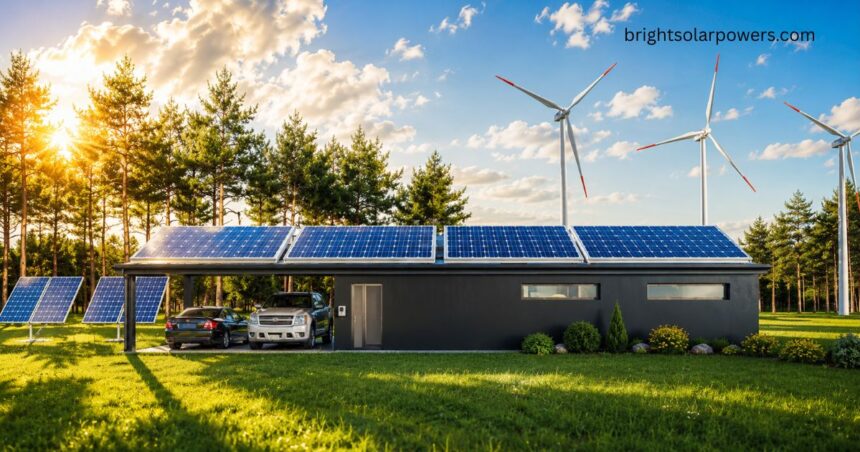
Rising costs and frequent outages are hybrid solar system pushing Indian households and businesses across India toward a smarter way to manage power.
A hybrid setup brings together solar panels, battery storage, and a grid connection, so homes get continuous power even when electricity costs climb or the grid instability strikes without warning.
Hybrid Solar System
Once you understand the core components and the real advantages of hybrid solar systems over plain off-grid systems or grid-tied systems, the installation cost starts to look like an investment in energy independence rather than just another bill, and this guide walks through exactly how that energy solution works from the ground up.
What Is a Hybrid Solar System ?
A hybrid system pulls power from three sources at once sunlight, stored batteries, and the utility grid which is what lets it adapt automatically to whatever a household throws at it.
Unlike grid-only systems, it keeps running through power hybrid solar system outages, and unlike purely off-grid setups, it stays connected so any excess power can flow back out through net metering.
In many states, that exported power earns bill credits, which quietly chips away at your bills while a grid-tied connection still backs you up when solar panels alone can’t cover grid power demand under changing conditions.
How a Hybrid System Works?
During the day, solar panels feed the home first, and any surplus energy tops up the batteries until they hit full battery capacity. Once battery levels hybrid solar system are topped up, extra output gets exported to grid; at night or on cloudy days, the system draws down the batteries, then shifts to grid power automatically once battery levels run low.
This automatic switching happens without any interruption to your power supply, which is exactly the outage-proof behaviour that plain on-grid setups, lacking any battery, simply cannot offer.
Key Components
The hybrid inverter acts as the control center of the whole setup, handling DC to AC conversion and deciding in real time whether power goes to the house, into storage, or out to the grid export line; a unit with MPPT technology keeps pulling peak hybrid solar system output from your solar panels even as sunlight conditions shift through the day.
On the panel side, cell quality determines how much DC electricity you actually get: half-cut cells, Mono PERC, and Topcon panels are the high-efficiency panels worth asking about, since better panel efficiency directly affects both power output and how well the system holds up during power outages.
For energy storage, lithium-ion batteries, especially LiFePO₄ cells, deliver faster charging, longer cycle life, and deeper discharge than older options, making them the stronger pick for night backup, while lead-acid tubular batteries remain a lower-cost alternative for smaller loads.
On top of that, smart monitoring through app hybrid solar system monitoring or on-screen monitoring gives you generation tracking and consumption tracking in one place, so surplus solar energy never goes unaccounted for.
System Types
A unidirectional hybrid solar UPS keeps things simple: solar power runs the home and tops up the batteries first, and only pulls grid power when needed.
A bi-directional hybrid system goes a step further by sending any surplus power export back out for bill credits through net metering.
Grid-tie hybrid inverters sit in between, prioritising hybrid solar system solar and battery charging before the grid, and pushing daytime surplus out to the grid when panels are producing more than the home needs.
Benefits
The biggest draw for most households is uninterrupted backup, with zero-delay switching that protects essential loads like medical equipment and hybrid solar system keeps critical business operations running through a cut without anyone noticing.
On the savings side, net metering compatibility plus strong self-consumption habits bring lower electricity bills and a faster ROI, especially once you factor in bill credits from solar power sent back to the grid.
These systems also hold up under heavy loads think air conditioners, refrigerators, pumps, and washing machines because high-efficiency panels paired with lithium batteries give better year-round yield and a longer system lifespan than a basic setup, all while outperforming standard on-grid systems during power outages and in home offices that can’t afford downtime.
Cost & Installation Factors in India
Pricing in India scales with capacity: a 3kW system suited to a medium home runs roughly ₹2,50,000 to ₹3,00,000 with about 8-10 hours backup, while a 5kW setup for a large home costs closer to ₹4,00,000 to ₹4,75,000 with 10-12 hours backup.
Step up to 10kW for offices, and expect ₹7,00,000 to ₹9,00,000 with 12-16 hours backup depending on load.
The final number also depends on battery technology, hybrid solar system inverter quality, panel efficiency, installation complexity, the brand you choose, and whatever subsidies are available in your state at the time.

Brand-Specific Product Mentions
Among the options on the market, a bi-directional hybrid unit rated 3KVA/48V stands out for combining full grid-tie ability with offline battery backup in one box.
Smaller uni-directional hybrid UPS models, sized at 1kVA and 2kVA, suit homes that just need lights and fans covered without a big rooftop footprint.
Look for programmable source priority, pure sine wave output, adjustable charging, plus short-circuit protection and deep-discharge protection these are the safety and control features that separate a reliable unit from a cheap one.
Conclusion
Getting the sizing right matters more than most buyers expect: larger homes running air conditioners and other heavy appliances need bigger units than smaller homes with only basic loads, and rooftop space often ends up being the real limit on power use.
What ties hybrid solar systems together is the combination of grid reliability and battery independence you get system sizing built around your actual needs, not a one-size-fits-all box. If you’re ready to move forward, most providers hybrid solar system offer an estimate tool, a contact page, and a store locator to help you take the next step.
FAQS About Hybrid Solar System
What is a hybrid solar system?
A hybrid solar system combines solar panels, battery storage, and grid connection in one setup. It delivers solar power, stored backup power, and reliable grid support whenever needed.
How much does a 1 kW hybrid solar system cost?
A 1 kW hybrid solar system typically costs ₹65,000 to ₹90,000, based on battery capacity and inverter quality. Costs also vary with brand choice, installation charges, and government subsidies.
What is a hybrid solar power system?
A hybrid solar power system blends on-grid and off-grid technology using a hybrid inverter and battery bank. It gives energy independence while staying safely connected to the utility grid.
Which is better, off-grid or hybrid solar system?
A hybrid solar system wins for most homes with battery backup plus grid reliability, unlike off-grid systems limited to remote areas. This makes hybrid the more flexible and future-proof choice for families.