

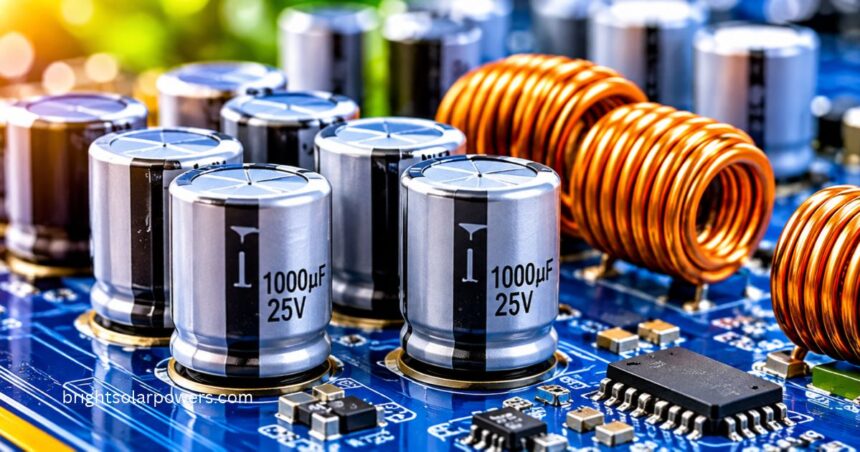
An ultracapacitor is an energy-storage device that holds charge in an electric double layer instead of in chemical reactions. Engineers also call it an electrochemical double-layer capacitor (EDLC), and it relies on electrostatic energy storage. That design gives it large capacitance, which engineers measure in farad (F), plus a fast charge and discharge rate.
Tecate Group says individual cells commonly fall between 100F and 500F, while Maxwell Technologies lists standard cells from 3F to 600F. A cell’s high-power energy storage works like a sprinter: it delivers instant power and rapid power delivery for seconds, not hours. Burst power and pulse power are its best jobs, because a primary energy source such as a battery or engine cannot respond that quickly.
Power density describes how fast a device releases energy, and energy density describes how much it holds. Ultracapacitors rank high on power density and medium on energy density. That balance explains why they suit backup power, regenerative power, quick charge, and cold starting.
How does an ultracapacitor store energy?
An ultracapacitor stores energy by pulling ions onto a porous carbon coating when voltage arrives. The activated carbon electrode offers a high surface area, so far more charge fits there than on a flat metal plate. No chemical reaction takes place, which keeps the process quick and repeatable.
A traditional capacitor places a dielectric between two plates, but an ultracapacitor replaces it with a thin carbon coating. The charges sit extremely close together, and that small gap raises capacitance sharply. During charging, ions in the electrolyte gather at the positive electrode and the negative electrode, then flow back during discharge.
What parts make up an ultracapacitor cell?
Every ultracapacitor cell contains a positive electrode, a negative electrode, a separator, and an electrolyte that fills the pores. Tecate builds its cells in a cylindrical construction, although some makers still prefer a prismatic design. Manufacturers coat activated carbon mixed with a binder onto aluminum foil and wind the layers into a jellyroll configuration.
Foil extensions weld to terminals, which carry current out of the cell. Tecate’s cells use an organic electrolyte, because it tolerates higher voltage than an aqueous (water-soluble) electrolyte does. Cells come with radial wire leads, radial snap-in leads, or axial threaded posts, and each one includes a safety vent that opens if pressure builds.
An ultracapacitor module groups several cells and adds a voltage management circuit. Tecate says its standard series-connected modules include voltage-management electronics. I always check that line on a datasheet before I compare anything else.
Which specifications should I check first?
Start with equivalent series resistance (ESR), rated voltage, and capacitance. Low internal resistance lets a cell deliver high current, and the rated voltage decides how many cells your design needs. Tecate’s standard cells carry ratings of 2.3V, 2.5V, 2.7V, and 3.0V.
Next, read the leakage current and self-discharge figures, which show how fast a charged cell loses energy without a load. Tecate lists a cycle life of 500k to 1M cycles and a calendar life of 10+ years, which together describe the long life buyers expect. Its wide operating temperature range runs from -40°C to +85°C, and its low-temperature performance holds down to -40°C, although extreme temperature effects still shorten life in heat and raise resistance in cold.
A datasheet also lists the working voltage, the maximum charged voltage, and the minimum voltage. The per-cell voltage usually sits near 2.7V, and the withstand voltage depends on the electrolyte. During discharge, the discharge current causes the voltage drop that you can read on the discharge curve.
Engineers model power loss with parallel resistance, a series inductor, and a ladder network. The time constant also explains why ultracapacitors stay out of AC circuits. A constant current discharge test then measures capacitance and ESR before you commit to a design.
How do series and parallel connections change a module?
A series connection adds cell voltages, while a parallel connection adds capacitance. Four 2.7V cells in series reach 10.8V, but four 10F cells in series fall to 2.5F of system capacitance. The same four 10F cells in parallel give 40F.
Because of that tradeoff, designers use series/parallel combinations built from matched cells. Small differences still cause voltage imbalance, so modules rely on passive balancing, which adds a bypass resistor across each cell, or on active balancing, which draws less current at rest. Some customers add temperature monitoring and an over-voltage alarm circuit for extra protection.
Ultracapacitor sizing starts with discharge current, discharge time, and the voltage drop your system allows. The result defines the full energy-storage system, and Tecate notes that letting voltage fall to half of working voltage releases about 75% of the stored energy. Its engineers also build a proof-of-concept prototype when a custom design needs validation.
Where do ultracapacitors work in real systems?
Ultracapacitors do two jobs: backup power and pulse power. In backup roles they support graceful shutdown, bridge power, and last gasp transmissions after a power failure. In pulse roles they supply peak power, so the primary source can stay smaller.
On the road and rails, they capture energy through regenerative braking, a process engineers also call braking energy recapture. Start/stop systems use them for voltage stabilization and cranking power, and Maxwell lists hybrid buses, semi-trucks, hybrid electric cars, and electric trains. Maxwell even lists aircraft door operation during power failure.
Wind turbine blade pitch systems, grid stabilization, renewable energy firming, and solar energy storage all use them. Maxwell also names lifting operations, and it lists data center and AI data centers among its applications. In a data center, they carry the load between a power failure and the start of diesel generator backup or fuel cell backup.
Which industries use ultracapacitors?
Tecate Group lists data center, industrial, medical, audio, military/aerospace, smart grid, and transportation markets, and its site also shows computing. Maxwell Technologies highlights automotive, grid, data center, and wind applications. Together, the two brands show how broadly ultracapacitors reach.
The ultracapacitor history explains this reach. The 1957 General Electric discovery of high capacitance in porous carbon came first, and Standard Oil of Ohio researchers developed the modern design in 1966. Early devices backed up VCRs, and they now serve consumer electronics and mission-critical applications.
Tecate supplies electronic assemblies beside its cells, and Maxwell frames its ultracapacitors around the future of power distribution. Both focus on the same need: dependable bursts of power. That shared focus makes their sites useful starting points.
How does an ultracapacitor compare with a battery or other capacitors?
The core difference is electrochemical vs. electrostatic storage. In an ultracapacitor vs. battery comparison, ultracapacitors win on internal resistance, cycle life, and temperature range, while batteries win on energy density. Tecate’s comparison table confirms each of those points.
Pairing the two brings battery life extension, because the ultracapacitor absorbs sudden loads that would otherwise cause battery voltage collapse. Ultracapacitors are also maintenance-free, and Tecate lists non-toxic materials as another advantage. I like this pairing because it lets a design use a smaller battery.
Other capacitors fill different roles. Tecate’s FAQ explains the conventional capacitor, ceramic capacitor, film capacitor, tantalum capacitor, and conductive polymer capacitor types. Tecate also lists a lithium-ion capacitor line with its own technology page.

What problems and safety risks should I know about?
Ultracapacitors rarely fail the way batteries do. Tecate defines end of life as the point where capacitance degradation or higher ESR no longer meets the application’s needs. Abuse conditions push a cell toward that point faster.
Over-voltage, over-temperature, and mechanical stress count as abuse conditions in Tecate’s FAQ. They can reduce capacitance, raise ESR, and trigger bulging and venting. Tecate keeps its cells and modules stored in discharged state for safety, and it recommends discharging any unit you will not install right away.
Assembly deserves attention too. Tecate’s cells meet RoHS compliance, which calls for lead-free soldering, and Tecate recommends an iron tip at or below 350°C for under three seconds to prevent soldering heat damage. It also advises skipping solvent cleaners such as acetone and washing with deionized water instead.
Which brands supply ultracapacitors?
Tecate Group, Maxwell Technologies, and Hyfindr all appear in this research, but they play different roles. Tecate and Maxwell supply ultracapacitors, while Hyfindr runs a B2B marketplace for the hydrogen industry. Each brand offers the services listed on its own website, so confirm details there.
Tecate Group, based in San Diego with over 40 years in electronic components, lists standard cells, standard modules, and custom ultracapacitor solutions. Its site confirms custom module design through a design questionnaire, custom cell evaluation, and proof-of-concept prototypes. Distributors and manufacturer’s representatives support its sales.
Maxwell Technologies, headquartered in Glendale, Wisconsin, lists Maxwell Standard Series cells, the Maxwell XP Series, and Maxwell DuraBlue cells. Its site also offers module information, downloadable documents, regional partners, and a contact form. Hyfindr lists power management modules under control units, and its service categories come from hydrogen-industry vendors.
What should I look for in a service provider?
Look for a provider that publishes specifications, explains its services in plain words, and answers technical questions. A clear datasheet should list ESR, rated voltage, capacitance, and cycle life. Services should appear on the provider’s own website, not only in a sales call.
Good providers also explain balancing, since a module without it shortens cell life. Tecate says its standard modules with series-connected cells include voltage management circuitry, which sets a useful benchmark. When I compare suppliers, I ask for the discharge curve and the ESR at the same temperature, because those two numbers expose weak designs quickly.
Check how a provider handles custom work. Tecate states that its engineers review non-standard cell requests, and Maxwell invites you to describe your application through its contact form. Confirm lead times, regional distributors, and documentation before you decide.
How can readers in Nampa find the right provider?
None of the three sites mentions Nampa, so confirm local availability before you plan a purchase. Tecate lists local regional distributors and manufacturer’s representatives, and Maxwell lists North America partners. Hyfindr’s listings serve the hydrogen sector, and its homepage shows no ultracapacitor listing.
A simple routine works well. Write down your voltage, current, and backup time, shortlist two or three providers, and send each the same questions. This website collects the specifications, brand details, and questions in one place, which saves you from reading every manufacturer page yourself.
What are the most common ultracapacitor questions?
How long does an ultracapacitor last?
Tecate lists a cycle life of 500k to 1M cycles and a calendar life of 10+ years. Batteries in the same table list 300 to 4,000 cycles and 3 to 5 years. Real life depends on voltage and temperature, so stay within the rated voltage.
Why do ultracapacitors need balancing?
Cells in a series string differ slightly in capacitance and leakage current. A cell with lower capacitance charges to a higher voltage and can exceed its rating. Passive or active balancing keeps every cell within its limit.
Do ultracapacitors work in AC circuits?
No, Tecate says their time constant makes them unsuitable for AC or high-frequency circuits. They suit DC systems that need bursts of power. Designers usually choose other capacitor types for AC work.
Can an ultracapacitor replace a battery?
Sometimes. Tecate says ultracapacitors can replace a battery or let you choose a smaller one, depending on the application. Their medium energy density means long-duration loads still need batteries.
Do ultracapacitors ship charged?
No. Tecate says its cells ship at zero voltage, so you must charge them before first use. It also keeps cells discharged during storage for safety.