
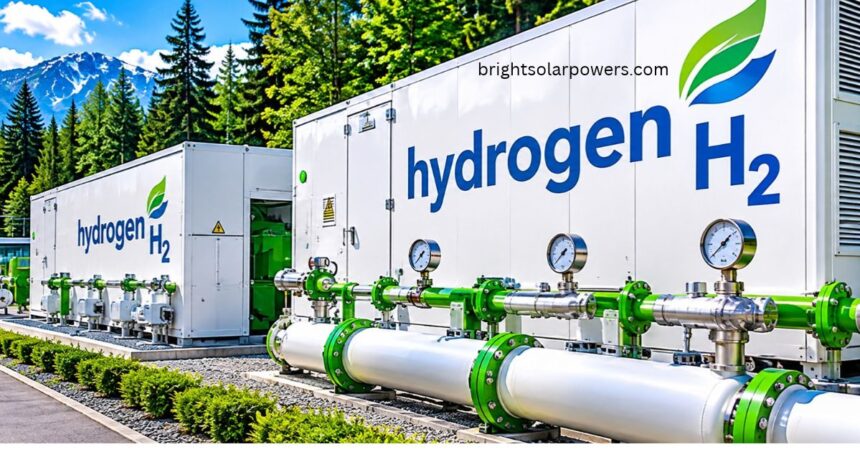
A solar hydrogen generator turns sunlight into stored fuel through solar-powered hydrogen production. This on-site hydrogen generation happens right beside the building that uses the fuel.
The core of the machine is an electrolyzer stack built from many electrolyzer cells. An alkaline electrolyzer handles splitting water with electricity, and a patented membrane keeps the gases apart. That hydrogen and oxygen separation protects hydrogen production, while the oxygen by-product returns to the air.
Why Would Anyone Store Sunlight as Hydrogen?
Sunlight disappears at night, but hydrogen waits in a tank until you need it. Storing renewable energy as hydrogen lets you save daytime power and burn it later as renewable hydrogen fuel. That makes hydrogen a practical fossil fuel alternative for machines and vehicles.
Hydrogen also helps the planet when it replaces diesel and gasoline. This environmentally friendly fuel shrinks your carbon footprint, and PEAK Scientific lists a lower environmental impact among its reasons to make gas on site. Millennium Reign Energy states that its systems run on grid power, wind and solar power, so any renewable energy source can feed them.
What Parts Make Up a Hydrogen Generator?
Every hydrogen generator performs five jobs: it makes the gas, cleans it, squeezes it, stores it, and hands it out. Hydrogen purification removes impurities, hydrogen compression raises the pressure, and hydrogen storage holds the result. Hydrogen dispensing finishes the chain when the gas leaves for a vehicle or an instrument.
Hardware matches those jobs one to one. A compressor feeds a hydrogen storage tank, a dispensing unit fills vehicle tanks, and automated valves steer the flow. A purge gas step and an oxygen purge clear the lines, and the SHFA line sits inside a stainless steel enclosure, where a ventilated enclosure design keeps air moving.
How Does a Solar Inverter Connect to an Electrolyzer?
A solar inverter converts panel output into the alternating current an electrolyzer expects. Millennium Reign Energy states that its AutoARK runs on wind and solar through the inverters of those sources. The same unit also accepts 240 volt line voltage or 120 volt line voltage from a wall circuit.
Efficiency decides your operating cost, so read the numbers. Millennium Reign Energy reports that its stacks use about 48 kilowatt hours per kilogram of hydrogen, which it equates to 423 standard cubic feet per kilogram. Its fully automated electrolyzer also performs waste heat recovery that can warm a home, and that energy efficiency makes on-site gas more cost-effective hydrogen.
How Much Hydrogen Can One System Produce?
Output depends on cell count. Millennium Reign Energy builds stacks of 11, 27, 55, 114 and 330 cells, and its range runs from 6.5 to 200 standard cubic feet per hour, or about 12 kilograms of hydrogen per day. That scalable hydrogen output lets you buy a right-sized system instead of an oversized one.
Small units suit a home hydrogen generator setup, and larger units serve small business hydrogen needs or farm applications. Millennium Reign Energy also names telecom applications and residential hydrogen power among its targets, and its menu points to mega-scale hydrogen production for far larger plants. Careful sizing keeps affordable on-site hydrogen within reach, because you skip capacity you never use.
What Do Hydrogen Purity Numbers Actually Mean?
Hydrogen purity shows how much of the gas is hydrogen. PEAK Scientific reports 99.99999% purity for its Intura line, Organomation lists 99.9999% purity for its H Series, and PEAK describes its Precision Hydrogen SL at 99.9995% purity. PEAK also describes its Intura output as moisture-free hydrogen, and each extra nine removes more unwanted gas.
PEAK Scientific bases its figure on oxygen content in ppm and cites independently verified purity from the National Physical Laboratory. Organomation states that its HG 2200 R keeps oxygen under 0.1 ppm when you add additional purifiers. Trace analysis cares about those figures because contamination risk grows with every impurity, while consistent gas quality keeps detector baselines steady.
Where Do Laboratories Use Hydrogen Generators?
A laboratory hydrogen supply from a generator serves GC carrier gas and GC detector gas needs. It can feed an FID as FID fuel gas, supply an FPD detector, and support GC-MS, GC-FID or fast GC work. PEAK Scientific also lists ICP-MS collision gas among its uses.
Organomation aims its HG 2200 R at THC analyzers and fume monitoring analyzers. Many labs treat generated hydrogen as a helium alternative and a gas cylinder alternative, because PEAK Scientific points to helium supply disruption and price increases. On-demand hydrogen supply also brings convenient hydrogen supply, reduced gas deliveries, a more secure supply chain and improved lab efficiency.

Which Vehicles and Machines Run on Generated Hydrogen?
A hydrogen fueling station fills fuel cell vehicles with gas made on site. Millennium Reign Energy builds hydrogen fueling infrastructure for forklifts, drones, buses and semi-trucks, and each fuel cell turns the gas back into power. The company lists Ohio State University among the organizations that use its generators.
The company plans a Transcontinental Hydrogen Highway along US Interstate 70 so fuel cell vehicles can refuel across the country. It also earned the Solar Impulse Efficient Solutions award, and its AutoArk Ed kit works as a hydrogen education kit for students. These projects show where small generators may lead.
Is a Hydrogen Generator Safe to Run?
A hydrogen generator stays safe when engineers design it and independent labs test it. PEAK Scientific states that on-site generation means no cylinder handling and no leak or explosion risk from bulk gas. Safe hydrogen generation also depends on ventilation, so airflow matters as much as electronics.
Millennium Reign Energy builds fail-safe features into its units, which aim for fail-safe operation that stays safe for inexperienced users. For CSA Group certification, it holds attestation certificates for CSA IR 4-14 electrolyzers and CSA IR 3-18 fueling appliances. Both passed third-party laboratory testing against codes and standards, and PEAK Scientific publishes a hydrogen safety standard article for GC users.
Which Brands Should I Compare for a Hydrogen Generator?
Compare PEAK Scientific, Organomation and Millennium Reign Energy first, because their websites document hydrogen products in detail. PEAK Scientific and Organomation serve laboratories, while Millennium Reign Energy serves homes, farms and fueling stations. Some shoppers search for a hydrogen maker, and these brands list the same device as a hydrogen gas generator.
Each brand offers the services listed on its own website, so check its support pages before you call. None of the pages I read names Nampa, so ask each company about coverage near you. I start every comparison with the support menu instead of the spec sheet, because service decides how ownership feels.
What Does PEAK Scientific Offer?
PEAK Scientific builds hydrogen generators for laboratories, including the Intura H2 range and several Precision Hydrogen models. The Intura H2 100 through 1500 sizes feed GC and ICP-MS work. The Intura H2|O2 supplies hydrogen and oxygen to the Shimadzu Nexis GC-2060.
The Precision Hydrogen Trace models serve carrier gas needs, while Precision Hydrogen SL gives GC-FID users a compact bench footprint. PEAK describes that SL unit as easy to maintain. The Intura series also includes a zero air generator and a nitrogen generator for a complete GC setup.
What Does Organomation Offer?
Organomation sells two hydrogen generators, the H Series and the HG 2200 R. The H Series comes in 200, 400 or 600 milliliters per minute flow, and it targets GC-MSD and fast GC carrier gas. The HG 2200 R exceeds 99.999% purity for its analyzers.
Organomation also lists a nitrogen generator range and a zero air generator range beside its evaporators. Its history page calls the company’s instruments low maintenance. That reputation comes from instruments that stay in service for decades.
What Does Millennium Reign Energy Offer?
Millennium Reign Energy designs, builds and distributes alkaline hydrogen generators under the AutoARK name. Each SHFA model combines generation, purification, compression, storage and dispensing in one hydrogen fueling appliance. Its patented electrolyzers scale from 11 cells up to the 330 Triple Twin, and the newest stacks use injection-molded cells.
Millennium Reign Energy holds US, Canadian and EU patents on its designs. It sells to homeowners, business owners and fleet operators. Its pages stress affordability and ease of operation for owners.
What Services Do These Brands List on Their Websites?
PEAK Scientific lists the most service detail, and Organomation lists support pages for repair and warranty. The Millennium Reign Energy pages I read confirm no repair or service options, so ask the company directly. Each brand offers only what its own website states, and you should confirm every item before you buy.
Which Services Does PEAK Scientific List?
PEAK Scientific lists service plans with a guaranteed response time, breakdown visits, an annual preventative maintenance visit and a technical support helpdesk. Those plans also include visual support through PEAK Visual Support. PEAK-certified field service engineers deliver on-site help.
The service menu also lists installation, spares and replacement parts, and warranty activation. An activated warranty brings technical support and parts and labor coverage. Readers should read the warranty statement for the exact terms.
Which Services Does Organomation List?
Organomation’s support menu lists a repair request, warranty and service registration, on-site services and extended warranties. Instruments carry at least a one-year standard warranty, and the site asks you to return the registration form within ten days. Organomation says it services what it builds.
Its resources add installation videos, manuals and guides, tech support videos and a trade-in program. The preventative maintenance guides on the site name its evaporators, so ask whether hydrogen generators get similar guidance. That question costs one phone call.
What Should I Look for in a Hydrogen Generator Service Provider in Nampa?
Look for a provider that documents its service in writing. Check for a stated response time, a repair route, warranty terms, a parts supply and installation help. A provider that lists these items gives you something concrete to compare.
When I help readers shortlist providers, I ask three questions: who answers after a breakdown, who supplies parts, and who installs the unit. I also ask whether the company covers Nampa, Idaho, because a lab-focused brand may route local work through a partner. My website gathers these brand details in one place, so you skip the hunt.
What Do Readers Ask Most About Solar Hydrogen Generators?
Does a hydrogen generator make electricity?
No. Millennium Reign Energy states that its generators split water with electricity and make no power themselves. A fuel cell turns the stored hydrogen back into electricity later.
Can solar panels run an electrolyzer directly?
Yes, through an inverter. Millennium Reign Energy states that its AutoARK runs on wind and solar through those sources’ inverters. Check your unit’s voltage and wiring before you connect anything.
How pure is generated hydrogen?
Purity depends on the model. PEAK Scientific reports up to 99.99999% for Intura, and Organomation reports up to 99.9999% for the H Series. Read each spec sheet before you choose.
Do all three brands offer the same services?
No. PEAK Scientific and Organomation each list their own services, and Millennium Reign Energy lists none on the pages I read. Confirm every service with the company.
How do I find a provider near Nampa?
List the services each brand states, then ask each company about Nampa coverage. Compare response times, parts supply and warranty terms side by side. My website collects those details for you.