

Rooftop solar systems have become a normal part of Indian homes today, and if you’re thinking about going solar, you’ve probably come across 3kW solar panel unit generation as one of the most searched terms.
This size sits right in the sweet spot for most families, and understanding exactly how many units it produces, what it costs, and how it’s maintained can save you a lot of guesswork.
We’ve gone through installer quotes, subsidy portals, and real household bills to lay it all out clearly.
Understanding 3kW Solar Panel Unit Generation
The easiest way to understand solar output is to start with kilowatt and kilowatt-hours (kWh). Kilowatt tells you the system size, meaning how much power your setup can produce under ideal sunlight conditions, while kWh, or units, tells you how much electricity actually gets used or generated over time.
There’s a simple formula behind this: multiply system size by peak sun hours, then by efficiency. So a 1 kW system getting 5 peak sun hours a day at 80% efficiency works out to 1 × 5 × 0.8, which lands around 4 units per day.
Scale that up, and a 3kW solar system typically generates 12 to 15 units per day, reaching the higher end during peak summer when it gets 8 to 9 hours of direct sunlight.
Looking at daily, monthly, and annual generation side by side makes the picture clearer. A 1 kW system typically gives 4–5 units per day, while a 3 kW system gives 12–15 units per day.
On a monthly basis, that works out to 120–150 units for the 1 kW system and 360–450 units for the 3 kW system. Over a full year, the 1 kW system generates around 1,400–1,800 units, while the 3 kW system generates 4,320–5,400 units, depending on your region’s solar radiation.
Real output always depends on a few things: your location, sunlight availability, tilt angle and direction of panels, dust or shading, and whether you’re using bifacial solar panels or N-Type TOPCON cells, since cells on both sides catch more sunlight in bifacial designs.
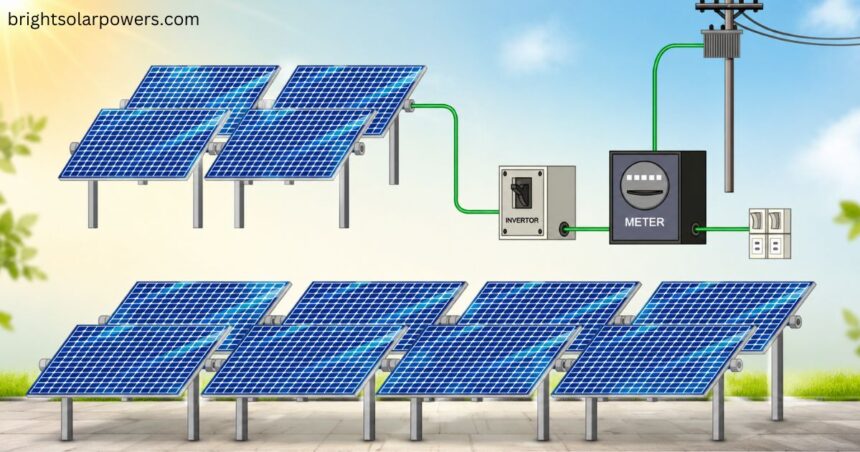
Any extra electricity you don’t use during the day doesn’t go to waste either. Thanks to net metering, it flows back to the grid in exchange for bill credits, which quietly reduces your electricity bill.
Technicalities and Specifications of a 3kW Solar System
A standard 3 kW setup, or 3000 W in full, usually comes with 8 to 10 solar panels mounted on your rooftop, connected to a solar inverter and a smart meter supplied by your electricity provider.
Installing this needs about 250–300 sq. ft. of open space, and it works best when the angle and direction of the panels are set correctly along with the inverter’s conversion capacity.
| Specification | Details |
| Solar Panel Type | N-Type TOPCON (common) |
| Total Capacity | 3 kW |
| Number of Panels | 8–10 (depending on wattage) |
| Panel Wattage | 370W–450W per panel |
| Panel Efficiency | 18%–22% |
| Inverter Type | String, Hybrid, or Off-grid |
| Battery Capacity (if added) | 150Ah–200Ah |
| Structure | Galvanized iron mounting |
| Area Required | 250–300 sq. ft. |
| Daily Output | 12–15 units/day |
| Panel Lifespan | 25+ years |
| Warranty | 10 years product, 25 years performance |
Key Factors Impacting Solar System Output
India’s abundant sunshine makes most regions suitable for solar power, but the amount of usable sunlight reaching the ground, known as solar irradiance, changes depending on where you live.
According to the Global Solar Atlas, cities like Ahmedabad enjoy higher solar irradiance, while Guwahati sees fewer peak sun hours because of cloudier conditions. Even so, high-efficiency panels and microinverters help maintain output in low-light or shaded conditions.
Technology and equipment choices matter just as much as location. Monocrystalline panels pack more energy yield into less space, while microinverters boost system reliability by letting each panel work on its own, unlike older string inverters, where one shaded panel drags down performance across the whole row.
Panel direction and tilt also decide how much energy you collect. In India, facing panels south captures year-round exposure and better output. And don’t underestimate basic cleaning dust and dirt on the surface quietly reduce performance over time.
Why Is a 3kW Solar System So Popular?
A 3 kW system covers the energy needs of most small to medium households running air conditioners, a fridge, a washing machine, and regular lighting, which is exactly why it’s become the go-to choice across India.
It’s genuinely affordable, and under the PM Surya Ghar Muft Bijli Yojana, it qualifies for the maximum central subsidy of ₹78,000 on residential rooftops. This cap applies even for larger systems.
The savings are hard to ignore too, often landing between ₹30,000–₹50,000 in yearly electricity bills. It also fits most rooftops, needing just 250–300 sq. ft. of space, which suits urban homes well.
Because it’s built with a modular, microinverter-based design, it works as a flexible starting point you can expand capacity later without reconfiguring the whole setup.
Is a 3kW System Right for You?
If your home runs medium to high energy-consuming appliances think air conditioners, refrigerators, washing machines, lights, and fans a 3 kW system generating 4,320–5,400 units annually should comfortably keep up. It even suits small offices or shops with moderate energy needs.
The real difference comes down to technology, and this is where a brand like Enphase stands out. Instead of relying on old-style string inverters, its IQ Micro inverters manage each panel separately, keeping things efficient even under partial shade or on complex rooftops.
Add real-time monitoring, the option to add panels or batteries later, and solid safety features, and you get strong savings, real scalability, and genuine peace of mind.
How to Calculate Your Energy Consumption
Working out your own usage isn’t complicated. Pull out your latest electricity bill and look for the total units consumed, usually found in the meter details section.
Since most bills come bi-monthly, simply divide that number by 60 to get your daily energy usage in units a quick way to check how a 3 kW system stacks up against what you actually consume.
Types of 3kW Solar Systems in India
There are three ways to set up a 3 kW system, and the right one depends on how connected you want to stay to the electricity grid.
On-Grid: Links directly to the grid, letting you use solar power during the day and draw from the grid at night. Excess energy gets exported through net metering. It suits homes with stable grid supply and high daytime consumption, needs no batteries, qualifies for the full government subsidy, and is easy to maintain.
Off-Grid: Works independently, storing power through battery storage for use during frequent power cuts. This makes it ideal for rural areas needing 24×7 supply, though it comes with no subsidy and added battery cost.
Hybrid: Combines both worlds, offering a grid connection plus battery storage and the option to export surplus power. It gives strong flexibility for a higher investment, qualifies for partial subsidy, and suits areas with moderate grid supply that still need backup power.
3kW Solar Panel System Price in India
The 3 kilowatt solar panel price in India isn’t fixed it moves between ₹1.5 lakh and ₹3 lakh depending on the system type.
| System Type | Approx. Price | Subsidy Eligible | Battery Included |
| On-Grid | ₹1,50,000–₹1,80,000 | Yes (full) | No |
| Off-Grid | ₹2,40,000–₹2,80,000 | No | Yes |
| Hybrid | ₹2,70,000–₹3,00,000 | Yes (partial) | Yes |
These figures cover panels, inverter, structure, wiring, and installation, though GST and local charges can add to it depending on your installer.
Before settling on a solar plant price, always check the brand, your exact installation location, the structure design, and current subsidy availability these four things swing the final number more than anything else.
Government Subsidy on a 3kW Solar System
Under the PM Surya Ghar Muft Bijli Yojana, the Government of India is pushing residential solar adoption through subsidy rates tied to system capacity, with the scheme running through FY 2026–27.
The Central Financial Assistance (CFA) works out to ₹30,000 per kW for the first 2 kW, then ₹18,000 for the next kW between 2–3 kW, capping at ₹78,000 for systems of 3 kW and above. This amount is transferred directly to your bank account once installation and inspection are complete.
Note: Subsidy rules and disbursement timelines are updated periodically. Always confirm the latest slabs and eligibility on the official portal, pmsuryaghar.gov.in, before publishing or advising readers.
Benefits of a 3kW Solar Setup
Lower electricity bills is usually the first thing people notice, often ₹3,000–₹4,000 per month depending on consumption and local tariff rates.
Quick return on investment (ROI): With subsidies and steady bill savings, most people recover their cost in 4–5 years, after which power is nearly free for another 20 years.
Low maintenance: Cleaning once or twice a month keeps maximum efficiency intact.
Eco-friendly: A 3kW system cuts around 3–4 tons of CO₂ emissions yearly.
Energy independence: Cuts your reliance on grid electricity and shields you from rising power tariffs.
Higher property value: Homes with solar installations are seen as more valuable and sustainable to future buyers.
Area Requirement for a 3kW Solar System
You’ll need roughly 250–300 sq. ft. of unobstructed rooftop space, and south-facing roofs work best since they catch maximum sunlight through the day. If your roof space is tight, carports, tin sheds, or other elevated structures work just as well.
Maintenance Tips for a 3kW Solar System
Keeping your system running well doesn’t take much effort. Clean panels with soft water and a soft cloth every 15–20 days, and regularly inspect for dust, bird droppings, or shading.
Check inverter readings now and then, and schedule an annual inspection with your solar provider. Avoid harsh chemicals during cleaning proper care keeps optimal performance and maximizes lifespan.
Cost Savings and Payback Calculation
For a 3 kW solar system, the cost after subsidy usually falls between ₹1,00,000 and ₹1,20,000. Monthly savings come to about ₹3,000, adding up to annual savings of ₹36,000.
That gives a payback period of 3–4 years, and with a system life of 25 years, understanding your 3kW solar panel unit generation early on helps you see how your total lifetime savings can reach ₹8–9 lakh a number that makes the initial cost far easier to justify.
FAQs About 3kW Solar Panel Unit Generation
How many units can a 3kW solar system generate?
A 3kW solar system generates around 12–15 units (kWh) per day. That’s roughly 360–450 units per month.
Can I run a 1.5 ton AC on a 3kW solar system?
Yes, a 1.5 ton AC uses about 1.5–2 kW, so a 3kW system can handle it well. Just watch your total load if other appliances run at the same time.
How many ACs can run on a 3kW system?
A 3kW system can comfortably run one 1.5 ton AC. Running a second AC at the same time isn’t practical due to limited power capacity.
What can a 3kW solar system power?
It can power essentials like lights, fans, a refrigerator, TV, and one AC — a solid step toward energy independence.
Can I run 2 ACs on a 4kW solar system?
A 4kW system may support two smaller ACs (1 ton each) with care. Two 1.5 ton ACs together would likely exceed its power capacity.